- English
- 简体中文
- Esperanto
- Afrikaans
- Català
- שפה עברית
- Cymraeg
- Galego
- 繁体中文
- Latviešu
- icelandic
- ייִדיש
- беларускі
- Hrvatski
- Kreyòl ayisyen
- Shqiptar
- Malti
- lugha ya Kiswahili
- አማርኛ
- Bosanski
- Frysk
- ភាសាខ្មែរ
- ქართული
- ગુજરાતી
- Hausa
- Кыргыз тили
- ಕನ್ನಡ
- Corsa
- Kurdî
- മലയാളം
- Maori
- Монгол хэл
- Hmong
- IsiXhosa
- Zulu
- Punjabi
- پښتو
- Chichewa
- Samoa
- Sesotho
- සිංහල
- Gàidhlig
- Cebuano
- Somali
- Тоҷикӣ
- O'zbek
- Hawaiian
- سنڌي
- Shinra
- Հայերեն
- Igbo
- Sundanese
- Lëtzebuergesch
- Malagasy
- Yoruba
- Español
- Português
- русский
- Français
- 日本語
- Deutsch
- tiếng Việt
- Italiano
- Nederlands
- ภาษาไทย
- Polski
- 한국어
- Svenska
- magyar
- Malay
- বাংলা ভাষার
- Dansk
- Suomi
- हिन्दी
- Pilipino
- Türkçe
- Gaeilge
- العربية
- Indonesia
- Norsk
- تمل
- český
- ελληνικά
- український
- Javanese
- فارسی
- தமிழ்
- తెలుగు
- नेपाली
- Burmese
- български
- ລາວ
- Latine
- Қазақша
- Euskal
- Azərbaycan
- Slovenský jazyk
- Македонски
- Lietuvos
- Eesti Keel
- Română
- Slovenski
- मराठी
- Srpski језик


Is an RFID Blocking Wallet Worth It?
When many people first hear about "RFID-blocking wallets," a question naturally arises: can they really prevent bank card information from being stolen?
This claim is not entirely unfounded. RFID-blocking materials can indeed attenuate or interrupt radio wave communication with the card, preventing scanning devices from successfully reading a card enclosed within the wallet.
However, there is a distinction between what an RFID-blocking wallet can block and the actual payment security of the bank card itself.
It is an exaggeration to assume that funds can be easily "skimmed remotely" simply because someone might approach your wallet with a scanning device in a subway, airport, or shopping mall. Modern contactless bank cards already employ multi-layered security mechanisms; an RFID-blocking wallet essentially serves as an additional physical barrier against wireless communication.
So, is an RFID-blocking wallet worth buying? The answer isn't as simple as asking whether it "works"; it depends on exactly what you are trying to guard against and the type of card you use.
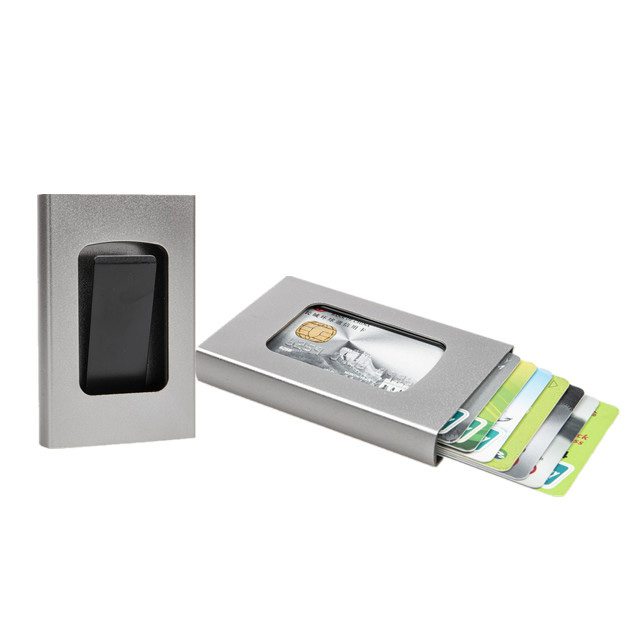
What Is RFID Blocking?
RFID, or Radio Frequency Identification, uses radio waves to exchange information between a reader and an electronic tag or card. Some passive RFID devices do not have their own battery. Instead, they receive energy from the reader's electromagnetic field and use it to communicate.
An RFID blocking wallet places a conductive or electromagnetic shielding material between the card and the outside environment. When the shielding is effective, it reduces the strength of the radio signal reaching the card and makes communication with an external reader more difficult.
In simple terms, RFID blocking does not delete or modify the information stored on a card. It creates a physical barrier that makes wireless communication more difficult.
Are RFID and NFC the Same Thing?
RFID and NFC are closely related, but they are not exactly the same.
NFC, or Near Field Communication, is a short-range wireless communication technology used in applications such as contactless bank cards, mobile payments, access cards, and other identification systems. It shares some of the underlying principles of RFID, which is why RFID and NFC are often discussed together.
This is also why an RFID blocking wallet can affect the normal operation of some NFC-enabled cards.
For example, if a contactless payment card is inside an effective shielding wallet, an external payment terminal will generally have difficulty communicating with the card through the wallet. When making a payment, the card can simply be removed from the wallet and used normally.
What Can an RFID Blocking Wallet Actually Protect Against?
Its most direct function is to reduce the opportunity for unauthorized wireless communication with contactless cards.
Normally, a compatible reader needs to establish wireless communication with a nearby card. When the card is enclosed by effective shielding material, that communication can be weakened or blocked.
This can be useful for people who carry several contactless cards, such as bank cards, access cards, transit cards, and other RFID or NFC cards.
However, RFID blocking only addresses wireless communication. It does not protect against every type of payment or account security risk.
For example, an RFID blocking wallet cannot prevent information from being obtained through phishing, malware, account compromise, social engineering, or the physical loss of a bank card.
Can Someone Really Copy a Bank Card Through Your Wallet?
This is one of the most commonly exaggerated claims surrounding RFID protection.
Contactless cards can communicate wirelessly with compatible readers, so unauthorized wireless access is a legitimate security consideration. However, being able to communicate with a card does not automatically mean that someone can completely clone a modern payment card and use it just like the original.
Modern EMV chip cards do not simply transmit a fixed set of payment information for every transaction. EMV contactless payments use transaction-specific security data, including dynamic authentication mechanisms designed to help protect individual transactions.
Therefore, it is misleading to describe the situation as someone simply walking close to you with an NFC device, copying your bank card, and immediately using it without restriction.
A more accurate way to understand RFID blocking is this:
The wallet adds a physical barrier at the wireless communication level, while the card and payment system provide additional security mechanisms during the actual transaction.
Why Use an RFID Blocking Wallet?
The main advantage is straightforward: the card remains shielded when wireless communication is not needed.
For people who carry multiple RFID or NFC cards every day, this can provide an additional layer of physical protection without changing how the cards are used once they are removed from the wallet.
An RFID blocking wallet can also be useful when you want to keep contactless cards from responding to nearby compatible readers during storage or transportation.
The key point is not that RFID blocking makes a card completely secure. Instead, it reduces unnecessary wireless exposure while the card is inside the wallet.
What Should You Look for When Buying an RFID Blocking Wallet?
The words "RFID Blocking" alone do not tell you very much about the actual construction of a wallet.
Pay attention to the shielding structure, coverage area, card-slot design, wallet materials, and available shielding test information.
For example, a wallet that uses shielding material only in a small section may not provide the same coverage as a design that surrounds the protected card area. Product construction and testing methods can also affect the actual shielding performance.
If a manufacturer provides information about tested frequencies, test methods, or shielding performance, that information is more useful than a simple RFID-blocking label.
It is also worth remembering that shielding can affect normal contactless operation. If you want to make a payment using the card's tap-to-pay function, you may need to take the card out of the wallet first.
The Practical Value of an RFID Blocking Wallet
An RFID blocking wallet uses shielding materials to reduce or block wireless communication between contactless cards inside the wallet and external readers, adding a physical layer of protection for bank cards, access cards, transit cards, and other RFID or NFC cards.
For people who regularly carry multiple contactless cards, this design can reduce the chance of those cards establishing wireless communication with external devices when such communication is not needed, while allowing normal use once the card is removed from the wallet.
When choosing an RFID blocking wallet, focus on the shielding structure, coverage, card-slot design, wallet materials, and available test information. These details provide a more useful basis for evaluating the product than simply looking for an "RFID Blocking" label.